
博客

为什么跑步机跑完会腿软?路跑vs跑步机的动力学、肌耐力与空气品质全解析
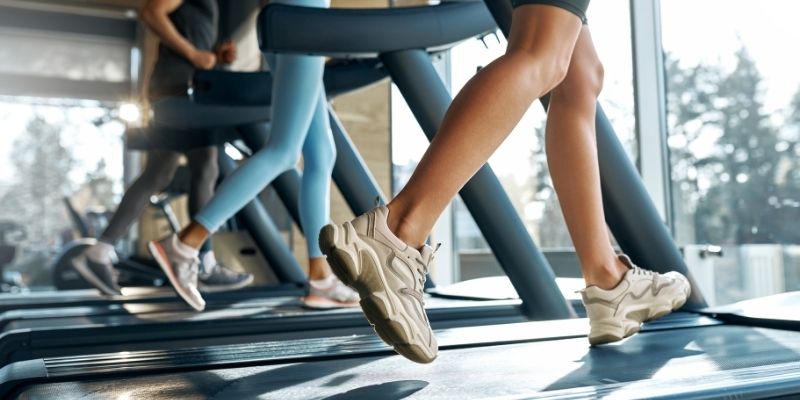
跑步机跑起来常常感觉脚步「飘飘感」、对于肌耐力的养成及健身房空气品质的疑虑,是许多人爱跑步的常跑者心中常见的疑问。以下整合机械动力学、肌耐力、心肺耐力、关节受力、优缺点及适合族群做全面性对比分析。
〈延伸阅读:戴口罩运动对心率、血氧饱和度及呼气末二氧化碳有什么影响? Meta-analysis分析一次看! 〉
路跑VS跑步机完整对照全解析
| 评估面向 | 路跑 | 跑步机 |
|---|---|---|
| 机械动力学 与跑步技巧 | 地面静止,跑者需主动向后推蹬,产生向前反作用力。需要更完整的髋伸展与踝推蹬技巧,对跑步技术要求高。 | 履带自动向后转,跑者只需抬起脚跟随速度,推蹬需求大减。容易出现「垂直跳跃」或「过度前掌着地」,长期可能改变步态,回到路跑时节奏感易偏差。 |
| 肌耐力 | 明显更吃小腿、腘旁肌、臀肌,尤其上坡或变速时。 对后侧动力链刺激较高,有助维持跑步经济性。 | 因履带协助向后带,对后侧动力链刺激较低,正如喜爱路跑者所说「对肌耐力养成略差」。 |
| 心肺耐力 | 需克服风阻与路面不稳定性,相同心率下能量消耗略高于跑步机(约5-10%),心肺挑战更大。 | 可精确控制速度/坡度,适合区间心率训练或间歇。但缺乏风阻,相同心率下能量消耗较低。 |
| 骨关节受力 与保护性 | 硬地反作用力大,长期易引发胫骨疲劳性骨折、髌骨股骨疼痛,但能强化骨骼密度与韧带适应性。 | 在平地模式下两者的地面反作用力数据相似;但若是进行上坡训练,路跑的关节负荷率才会显著大于跑步机。此外,步频过低(<170步/分)时容易因错误姿势增加冲击。 |
| 优点 | 真实比赛感、锻炼全身协调与推蹬肌群、心理满足感高。 | 不受天气影响、可精确监控心率/配速、关节冲击较低。 |
| 缺点 | 夏季高温易致热伤害、路面硬、需注意交通与空污。 | 单调易无聊、肌耐力训练效果差、散热不良(需风扇或空调)。 |
| 适合族群 | 备赛跑者、追求跑步技术与肌耐力者。 | 初学者、膝盖不适者、天气恶劣时维持心肺。 |
(手机版表格可左右滑动)
空气品质-路跑时常被忽略的核心重点
健身房空气品质分析
健身房通常人事成本及租金高,许多并无设置空气清净机,若有设置则多数只有空调滤网(无法过滤PM2.5),且二氧化碳浓度常偏高,若无独立新风+HEPA,因为空气分子流通无阻,室内PM2.5其实与室外相差无几,甚至因为扬尘、清洁剂、霉菌、病毒而空气品质更差。
设有「中央管理方式之空气调节设备(中央空调)」的建筑物室内作业场所,依劳工作业环境监测实施办法规定,雇主必须每6个月实施一次二氧化碳(CO2)浓度监测,CO2八小时日时量平均容许浓度为5000ppm。根据室内空气品质管理法,针对公告场所(如办公场所、商场等),二氧化碳室内空气品质标准值为1000ppm以下,依此判定室内空气品质是否达合格的标准,若超过此数值,通常代表外气换气量不足。
〈延伸阅读:揭开超强体适能的密码:睡眠心率30与储备心率150的强悍真相〉
健身房空气品质核心结论
多项研究证实健身房内PM2.5尖峰可达数百µg/m³,CO₂常超过1000ppm,室内PM2.5与室外高度相关且内源污染可能使浓度更高。因此一般健身房若无HEPA+独立通风,空气品质未必优于通风良好之户外公园。家中跑步机+空气清净机,能创造比户外干净的空气,是气喘、过敏或空污紫爆日的最佳选择。
「室内跑步空气一定比较好」是迷思。唯有密闭空间搭配高效空气清净机+独立通风系统才有优势,否则路跑选择公园、河滨等远离大马路交通尖峰的时段(如雨后、清晨),空气可能反而更佳。
〈延伸阅读:气喘发作怎么办?了解气喘症状的表现,掌握正确急救观念! 〉
路跑综合建议
夏季可混合训练
一周2次跑步机做间歇/坡度走(保护关节、稳定心率),1-2次清晨或夜间路跑(维持肌耐力与跑感)。
若只用跑步机,过去常建议设定1%坡度补偿风阻,但最新研究发现视跑步机机型不同,平地模式的负荷可能已等同或高于路跑,建议视机型与个人体感弹性调整,并每15分钟补充水分、搭配风扇降温。
注意空气品质
出门前查询空气品质指标(AQI),若AQI>100时改室内;若在家中跑步,开清净机并关窗;若去健身房,观察是否有空品监测或空气清净设备。
常跑者的「飘飘感」与肌耐力不足,正是许多跑者从跑步机转回路跑时「腿软」的主因。跑步机是方便的工具,但无法完全取代路跑对神经肌肉协调的训练。建议可以针对不同情况下弹性搭配选择路跑或跑步机。
〈延伸阅读:空气污染与肺癌关系攻略:PM2.5防护、清肺饮食与早期筛检〉
参考文献
- Jones, AM, & Doust, JH (1996). A 1% treadmill grade most accurately reflects the energetic cost of outdoor running. Journal of Sports Sciences, 14(4), 321–327.
https://doi.org/10.1080/02640419608727717 - Nolè, M., Baumann, G.-A., Spengler, CM, & Beltrami, FG (2024). Should a 1% gradient be used to equate the metabolic cost between treadmill and overground running? Current Issues in Sport Science, 9(2), Article 064.
https://doi.org/10.36950/2024.2ciss064 - Yao, J., Guo, N., Xiao, Y., et al. (2019). Lower limb joint motion and muscle force in treadmill and over-ground exercise. BioMedical Engineering OnLine, 18, Article 89.
https://doi.org/10.1186/s12938-019-0708-4 - Firminger, CR, et al. (2018). Joint kinematics and ground reaction forces in overground versus treadmill graded running. Gait & Posture, 63, 109–113.
https://doi.org/10.1016/j.gaitpost.2018.04.042 - Ramos, CA, et al. (2014). Exposure to indoor air pollutants during physical activity in fitness centers. Building and Environment, 82, 349–360.
https://doi.org/10.1016/j.buildenv.2014.08.026 - Alves, C., et al. (2014). Particulate matter in the indoor and outdoor air of a gymnasium and a fronton. Environmental Science and Pollution Research, 21(21), 12390–12402.
https://doi.org/10.1007/s11356-014-3168-1 - Abtahi, M., et al. (2023). Is practicing indoor physical activity safe? Consideration of exposure to PM2.5. Iranian Journal of Public Health, 52(12), 2703–2705.
https://doi.org/10.18502/ijph.v52i12.14333 - Faubel Alama, C.; Martinez-Molina, A. (2026). Indoor Air Quality Evaluation in a High-Intensity Physical Athletic Facility: CO2 Generation and Required Fresh Air Rates Calculation Methodology. En Editorial Universitat Politècnica de València, Proceedings - 4th Valencia International Biennial of Research in Architecture - Wellbeing for all. VIBRArch (pp. 422-430).
https://doi.org/10.4995/VIBRArch2024.2024.17762 - Zhai, Y., Zhang, H., & Arens, EA (2020). Preferred temperatures with and without air movement during moderate exercise. Energy and Buildings, 207, 109565.
https://doi.org/10.1016/j.enbuild.2019.109565 - Milner CE, Foch E, Gonzales JM, Petersen D. Biomechanics associated with tibial stress fracture in runners: A systematic review and meta-analysis. J Sport Health Sci. 2023 May;12(3):333-342. doi: 10.1016/j.jshs.2022.12.002. Epub 2022 Dec 5. Erratum in: J Sport Health Sci. 2025 Dec;14:101019.
https://doi.org/10.1016/j.jshs.2024.101019 - Callahan, EA, Chin, KE, & Chu, SK (2025). Current Evidence of Evaluation and Management of the Athlete with Patellofemoral Pain Syndrome. Current Physical Medicine and Rehabilitation Reports, 13(1), 1–
https://doi.org/10.1007/s40141-025-00502-9 - Slezakova K, Peixoto C, Oliveira M, Delerue-Matos C, Pereira MDC, Morais S. Indoor particulate pollution in fitness centres with emphasis on ultrafine particles. Environ Pollut. 2018 Feb;233:180-193.
https://doi.org/10.1016/j.envpol.2017.10.050 - Andrade, A., & Dominski, FH (2018). Indoor air quality of environments used for physical exercise and sports practice: Systematic review. Journal of Environmental Management, 206, 577–586.
https://doi.org/10.1016/j.jenvman.2017.11.001 - Li, G. (2024). Air Quality in Fitness Centers: Status and Improvement Strategies. E3S Web of Conferences, 536, 01017.
https://doi.org/10.1051/e3sconf/202453601017 - Chamseddine, A., Elzein, IM & Hassan, N. Indoor Air Quality in Critical Indoor Environments: A Review Paper. Water Air Soil Pollut 236, 885 (2025).
https://doi.org/10.1007/s11270-025-08512-y


陈承勤医师
致力于改善工作环境中的危害风险,通过创新计画和实证研究,综合个人健康风险及职场工作适能评估,给予员工及企业最专业的建议,秉持着「医疗永远是天秤两边去抉择,利大于弊:建议,弊大于利:不建议」的原则。因此在每项建议背后,皆是经过审慎评估与专业判断的结果,帮助企业减少职场伤害,提升员工幸福感。健康的员工不仅能提升企业的生产力,还能打造和谐的工作氛围。
不蹭流量、不搞话术、不带风向、不卖焦虑——秉持每一句卫教、每一篇文章、每一本书、每一堂课、每一个理论、每一个信念、每一个行动,都对得起实证医学、从不违反医疗伦理、皆是能落地的健康实践策略,以及日复一日身体力行的良心,以医疗伦理为秤、实证医学为盾,分享每一篇值得信赖的内容,也诚挚欢迎各界进行学术交流与讨论。